Why the Hotel Shower Is the Tall Traveller's Real Problem, Not the Flight
Quick Answer: Flights are a few hours and hotel rooms are the rest of the trip, but tall travellers spend all their planning energy on the seat. Bed length, shower head height, and doorway clearance vary enormously by country and hotel age, and almost all of it is knowable before booking - through room photos, hotel age, and a single question emailed to the property.
You paid for the extra legroom, boarded happy, and arrived at a hotel where you spent five nights showering in a crouch and sleeping with your feet over the end of the bed.
The flight was four hours. The room was a hundred and twenty. Almost every tall traveller optimises the wrong one, and the fix costs one email.

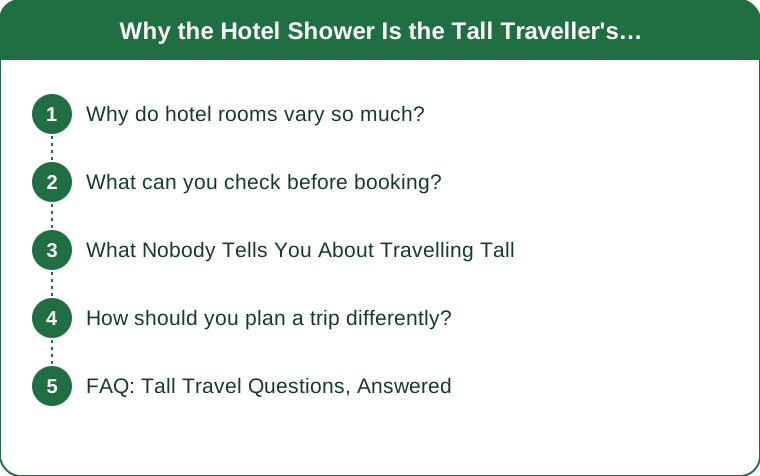
Why do hotel rooms vary so much?
Because bed sizes, plumbing conventions, and ceiling heights are national rather than international, and hotel age matters as much as star rating.
Bed length is the big one and it is genuinely regional. A standard double in some European countries runs shorter than a US queen, and older properties in Japan and parts of southern Europe are shorter again. A person at 6ft can find their feet over the end in one country and be perfectly comfortable in another at the same price point.
Shower head height follows local plumbing habits and building age. Fixed shower heads in older European and Asian properties are frequently mounted at a height that works for average users and not for tall ones, and a fixed head cannot be adjusted. Handheld heads on a rail are the tall traveller’s friend, because the rail usually offers several inches.
Doorways and beams are a real problem in converted and historic buildings - the charming boutique hotel in an eighteenth-century townhouse has low door frames and sloping attic ceilings, and the top-floor room with the view is often the one with the beam.
And bathroom mirror height is set to the sink, which is set to an average. It is a small thing that is a daily irritation for a week.
None of this correlates with price. A modern three-star chain hotel frequently beats a five-star historic property comprehensively on all four counts.
What can you check before booking?
More than most people realise, and it takes about five minutes.
Read the room photos for the shower. A handheld head on a vertical rail is good news. A fixed head coming out of the wall at a visible height relative to the door frame is assessable - door frames are roughly standard, so use them as a ruler in any photo.
Check the building’s age and type. New-build chain hotels are the safest bet for tall guests. Converted historic buildings are the riskiest, however lovely they look.
Look at the bed in the photos relative to the bedside tables and the headboard, and check the listed bed size in the room description. Then look up what that size actually means in that country, because a double in one place is not a double in another.
Email and ask one question. This is the highest-return step and almost nobody does it. A short message - can you tell me the length of the bed and whether the shower head is adjustable, as I am 6ft 1 - gets a helpful answer from most properties and occasionally gets you moved to a better room on arrival.
And check the top-floor and attic-room rate. If the cheapest rooms are on the top floor of an old building, there is usually a ceiling reason for that price.

What Nobody Tells You About Travelling Tall
Ask at check-in, every time. Hotels frequently have a small number of larger rooms, accessible rooms with roll-in showers and better clearances, or rooms with a different bed configuration. Asking politely at the desk costs nothing and works surprisingly often, particularly on a quiet night.
Two singles pushed together are sometimes longer than the double. In several European countries the twin beds in a room are a different length from the double, and occasionally longer. It is worth asking rather than assuming.
The aisle seat is not automatically the right choice. Aisle seats offer stretching room and cost you a shoulder and elbow to the trolley for the entire flight. For a tall traveller who sleeps, a window seat in a row with a bulkhead or a missing seat in front is frequently better, and the seat maps that show this are freely available.
Rental cars need checking too. Driver seat travel and headroom vary hugely between models in the same class, and the compact you booked online may not adjust far enough back. Booking a category up is the cheap fix, and specifying at the counter is the free one.
And pack for the shower. A cheap suction-cup hook or a travel shower head are absurd-sounding items that experienced tall travellers carry, because a fixed low shower head for a week is a genuinely miserable experience and a hook to hang a handheld one higher weighs almost nothing.
How should you plan a trip differently?
Reallocate the planning effort from the flight to the accommodation, and standardise a few checks.
Spend the research time on the room, not the seat. The flight is a few hours and the seat is largely a paid upgrade decision. The room is where the trip actually happens.
Build a two-line email template and send it to any property you are unsure about. Bed length, shower adjustability. That is it.
Prefer new-build over converted when you have the choice and the trip is longer than two nights. For a single night anything is survivable; for a week the difference is substantial.
Book the flight seat with a seat map rather than by instinct. Exit rows, bulkheads, and the rows behind a missing seat are worth more than a general preference for aisle or window, and they are visible in advance.
Carry the small kit. A suction hook, a compact travel pillow that supports a longer neck properly, and compression socks for long flights, where a tall traveller’s circulation has further to work.
And use autumn travel to your advantage. Shoulder season means lower occupancy, which is exactly when a request for a larger room or a different bed configuration is most likely to be granted. The same question that gets a no in July gets a yes in October.
FAQ: Tall Travel Questions, Answered
Are accessible rooms appropriate to request?
Not as a preference, since they are allocated to guests who need them. It is entirely reasonable to mention height at booking and let the hotel decide what suits, and many properties have larger standard rooms they will offer.
What bed size should I look for abroad?
Check the length in centimetres rather than the name. Around 200cm is comfortable for most tall travellers, 190cm is short for anyone above about 6ft, and bed names translate unreliably between countries.
Is premium economy worth it for a tall traveller?
On flights over about six hours, most tall travellers find the extra seat pitch worth more than any other travel upgrade. On shorter flights an exit row at a modest fee usually delivers most of the benefit for a fraction of the cost.
TL;DR:
- Bed length, shower head height, ceiling clearance, and mirror height vary by country and building age, and none of it correlates with price.
- Room photos, building age, and one emailed question answer nearly all of it before you book.
- Ask at check-in every time, consider twin beds, and check rental car seat travel as well as flights.
- Shoulder season is when hotels are most willing to accommodate a room request.
Tall travellers spend their planning energy on four hours and accept whatever the other hundred and twenty bring. Swap the effort round and the trip changes completely.
Keep Reading
This article is for general informational and styling purposes only. Fit, sizing, and product availability may vary.
