Why Rolling Luggage Wrecks Tall Women's Shoulders — and the Fix Nobody Sells You
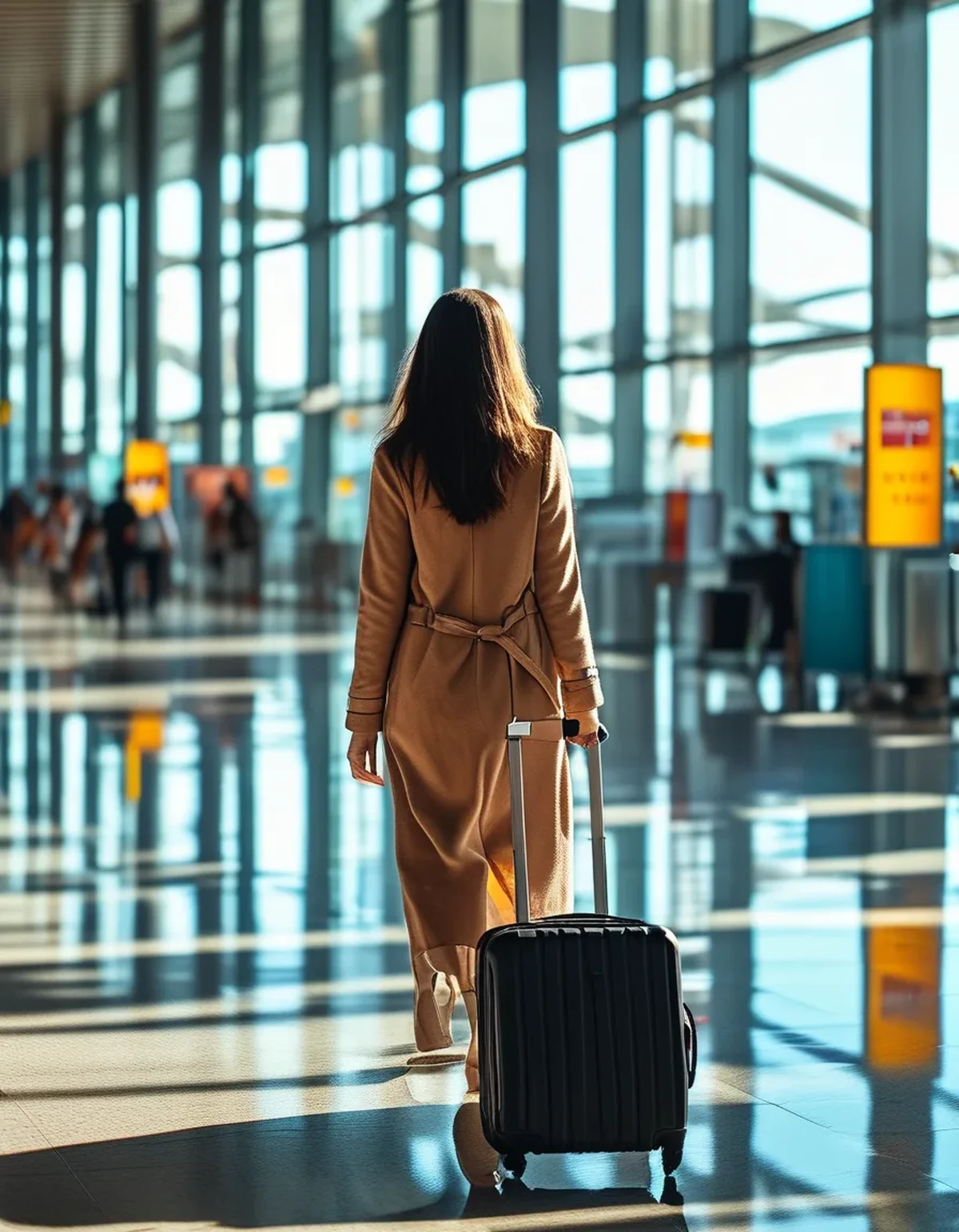
Quick Answer: Most telescoping luggage handles extend to roughly 38 to 42 inches from the ground, which sits well below the natural hand height of a woman over 5’10”. The result is a permanently hiked shoulder, an internally rotated arm, and a twisted torso for the entire walk through a terminal. The fixes that actually work are a four-wheel spinner pushed at your side rather than pulled behind you, switching hands every three minutes, and choosing a bag whose handle is at least 42 inches — a spec almost no brand publishes.
You get off a six-hour flight and one shoulder is furious. Not the flight shoulder. The suitcase shoulder. And it happens every single trip, on every bag you have ever owned.

Why does luggage hurt taller travelers specifically?
Because handle height is designed around an average, and you’re not standing on it.
The industry standard tops out low. Extended telescoping handles typically reach 38 to 42 inches from the floor. That number was set around a median adult user. A woman at 5’11” has a relaxed hand height closer to 30 inches from the floor when standing, but the relevant measurement is different — it’s the height at which your arm can hold a handle behind you without the shoulder lifting. For taller frames, that comfortable trailing-arm height is often 44 inches or more.
A too-low handle forces three compensations at once:
- The shoulder hikes toward the ear to shorten the effective arm length
- The arm internally rotates so the elbow flares out
- The torso rotates slightly toward the bag, which throws the pelvis off
None of those are sustainable for twenty minutes. Terminal walks routinely run fifteen to twenty-five minutes, and connection sprints run longer.
The load is also asymmetric and constant. Unlike carrying groceries, you don’t set the bag down. It’s a continuous low-grade pull on one side of the body, in a slightly wrong position, for the entire duration.
And it compounds with the bag on your other shoulder. Most travelers carry a personal item on the opposite side, which means one shoulder is hiked under tension and the other is loaded downward. That’s a rotational load on the spine, held for the length of a terminal.
What should you actually look for in a bag?
Four specs, and only one of them is usually printed on the label.
1. Extended handle height above 42 inches. This is rarely listed. Measure in the store from floor to the top of the fully extended grip. Anything at or above 42 inches is meaningfully better; 44 or more is genuinely comfortable for most women over 5’11”. Some brands offer a taller handle on the larger checked sizes and the shorter one on carry-ons — worth checking, since the carry-on is the one you actually walk with.
2. Four-wheel spinner, not two-wheel roller. This matters more than handle height. A spinner rolls upright beside you, which means the arm hangs nearly straight down and the shoulder stays neutral. The handle height problem largely disappears because you’re not reaching behind you. The tradeoff is worse performance on carpet and cobblestones, where you’ll want to tip it back and pull anyway.
3. Stage-lockable handle. Handles that lock at multiple heights, rather than only fully-in or fully-out, let you find the least-bad position when the maximum is still short.
4. Low bag weight. Every pound of empty bag is a pound of continuous shoulder load. The difference between a 6-pound and a 9-pound carry-on is noticeable at minute fifteen.
What doesn’t help as much as advertised: ergonomic grip shapes, padded handles, and “anti-shock” wheels. The problem is geometry, not comfort at the point of contact.
5 Mistakes Tall Travelers Make With Luggage
1. Pulling behind instead of pushing beside. With a spinner, keeping the bag at your side and pushing it means the arm stays down and the torso stays square. Most people default to dragging it behind out of habit, which reintroduces the entire problem.
2. Never switching hands. Twenty minutes on one side is what creates the day-after ache. Switch every three to five minutes. Set the habit at a landmark — every time you pass a gate number ending in zero, swap. It’s ridiculous and it works.
3. Loading the personal item on the same side. Backpack-style personal items distribute across both shoulders and eliminate the counter-rotation. A crossbody worn on the opposite hip is the second-best option. A tote on the free shoulder is the worst, because it forces that shoulder up too.
4. Buying the bag sitting down. Luggage is almost always evaluated in a store aisle where you extend the handle, nod, and buy. Walk twenty steps with it, ideally with weight in it. The shoulder hike shows up immediately if you’re paying attention.
5. Choosing the bigger bag because “more room.” A larger checked bag with a taller handle sounds like the fix, but a heavier bag pulled at the same wrong angle is worse, not better. The wheels-and-height combination matters more than volume.
The one that surprises people: a cheap, light, four-wheel bag with a mediocre handle often beats an expensive two-wheel bag with a great handle, purely because of the arm position it allows.
How do you fix the pain once it’s already there?
The ache is usually the upper trapezius and levator scapulae — the muscles that do the hiking — plus occasional irritation where the shoulder blade should be gliding but isn’t.
In the terminal, immediately:
- Set the bag down. Roll both shoulders backward ten times, slowly.
- Chin tuck: draw the chin straight back, hold 5 seconds, 8 repetitions. This resets the forward head that comes with the twisted posture.
- Doorway or wall pec stretch, 30 seconds each side. The chest tightens because of the internal rotation, and stretching the chest often relieves the shoulder more than stretching the shoulder does.
On the plane:
- Every 45 minutes, shoulder blade squeezes: pull the shoulder blades toward each other, hold 5 seconds, 10 repetitions.
- Neck side bend, ear toward shoulder, 30 seconds per side, with the opposite hand tucked under your thigh to anchor.
That evening:
- Heat on the upper trap for 15 minutes, then gentle movement. Heat first, then move — heat alone stiffens back up.
- Sleep with a pillow height that keeps the neck neutral. Side sleepers with broad shoulders usually need a thicker pillow than the hotel provides; a folded towel under the pillow closes the gap.
When it’s not just muscle: numbness or tingling down the arm, pain that wakes you, or weakness gripping things are signals to stop self-managing. Those point toward nerve involvement rather than a tired trapezius.
This is general information, not medical advice.
What’s the realistic travel-day setup?
A system, not a single purchase.
Bag: Four-wheel carry-on, under 8 pounds empty, handle measured above 42 inches if you can find it.
Personal item: Backpack, worn on both shoulders, or a crossbody on the opposite side from whichever hand is on the suitcase at the time.
Walking: Push beside, don’t pull behind. Switch hands on a schedule rather than when it starts hurting — by the time it hurts, the compensation has been running for a while.
Weight distribution inside the bag: Heavy items low and over the wheels. A top-heavy bag tips and requires more stabilizing force from the arm, which is more shoulder work than the pulling itself.
Security line strategy: This is where most of the standing-and-shuffling happens. Set the bag flat rather than holding it upright with the handle out — small thing, meaningful over a twenty-minute queue.
Long connections: If you have more than a twenty-minute walk, it’s worth putting the personal item on top of the suitcase (most have a pass-through strap) and going hands-free with everything on wheels.
The honest summary: the tall-traveler luggage problem is not solvable by buying the right bag, because the right bag mostly doesn’t exist at the height you need. It’s solvable by changing the arm position, which the four-wheel spinner does almost for free.
FAQ: Tall Traveler Luggage Questions, Answered
Are there luggage brands that make taller handles?
Some do, though it’s rarely marketed. Larger checked-size bags within a line usually have taller extended handles than the carry-ons, and a handful of brands publish handle specs. The reliable approach is to measure in-store from floor to grip rather than trusting a product page.
Is a backpack better than a rolling bag if I’m tall?
For loads under about 20 pounds and walks under 30 minutes, often yes — it’s symmetric, which removes the whole rotational problem. Beyond that weight, wheels win, because spinal loading from a heavy pack becomes the bigger issue.
Why does only one shoulder hurt when I use both hands?
Usually because you don’t actually use them equally. Most people have a strong default side and swap only briefly. Timing the swap rather than doing it by feel evens it out surprisingly fast.
TL;DR:
- Telescoping handles top out near 38–42 inches, below the comfortable trailing-arm height of most women over 5’10”.
- The result is a hiked shoulder, flared elbow, and rotated torso held for the length of a terminal walk.
- The single biggest fix is a four-wheel spinner pushed at your side, which keeps the arm hanging straight down.
- Switch hands every three to five minutes on a schedule, and carry the personal item as a backpack rather than a same-side tote.
The bag industry isn’t going to fix its handle height any time soon. Changing the arm angle costs nothing and solves most of it.
Keep Reading
This article is for general informational and styling purposes only. Fit, sizing, and product availability may vary.
