Why Long-Distance Coach Travel Is the Hardest Seat for Tall Travellers
Quick Answer: Coach seat pitch typically runs 68 to 78 cm, comparable to or tighter than economy air travel, but journeys are often four to eight hours with fewer chances to stand. The seats that work are the front row behind the driver, the row beside the centre door, and the row in front of the rear stairwell - all of which have open floor rather than a seat back in front. Book early, board early, and choose an aisle over a window every time.
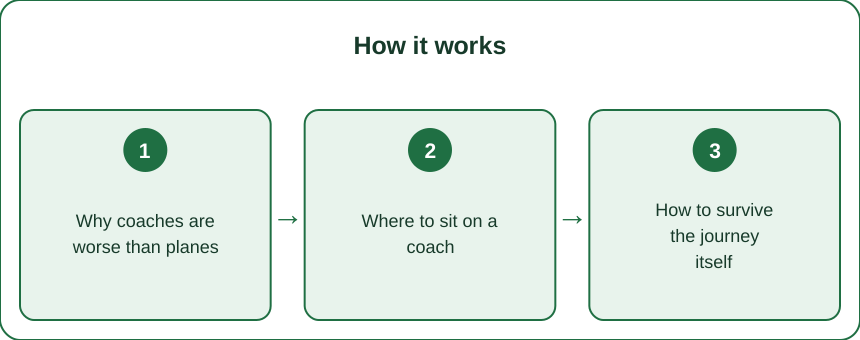
Here is where to sit, what to bring, and how to break up the journey.

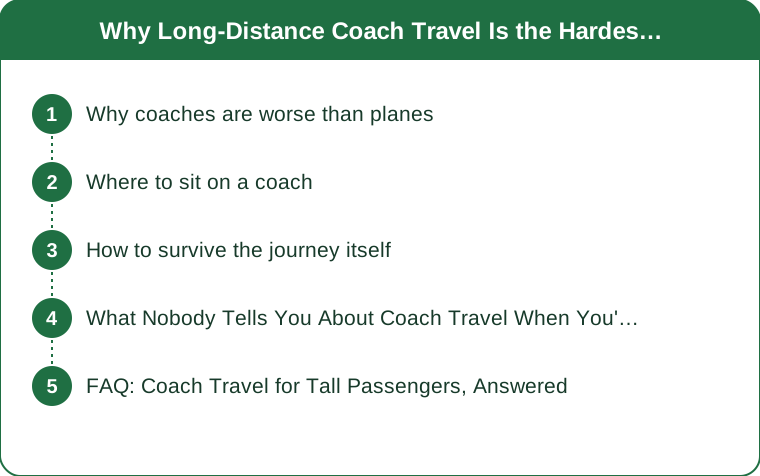
Why coaches are worse than planes
Seat pitch is comparable or tighter. Long-distance coaches typically run 68 to 78 cm of pitch, which is at or below the level of most short-haul economy cabins.
The journeys are longer in seat. A four to eight hour coach journey with two short breaks means more continuous sitting than most short-haul flights, without the cabin space to move around in.
There is no aisle to walk. On a plane you can stand and move; on a moving coach you generally cannot, which removes the main relief available on a long journey.
Seats often do not recline meaningfully, and where they do, the recline in front of you eats the little space you have. A reclined seat in front is far more consequential at 70 cm of pitch than at 85.
And there is no equivalent of the bulkhead or exit row in the booking system. Planes let you pay for legroom; most coach operators do not offer that option at all, so knowledge of the layout replaces money.
Luggage rules make it worse. With a bag at your feet you lose the only floor space you had, which is why what goes overhead versus underfoot matters more here than on a plane.
Where to sit on a coach
Front row behind the driver, where the layout allows it. There is frequently no seat directly in front, just a partition or a step, which gives the most legroom on the vehicle.
The row beside the centre door on double-door coaches. This often has open floor in front of it for door access, and it is regularly overlooked by other passengers.
The row immediately in front of the rear stairwell or toilet sometimes has extra space, though check - sometimes it does not recline as compensation, which is a fair trade for legroom.
Avoid the rear rows on most coaches. Pitch is often tightest there, the floor is frequently raised over the engine or the luggage hold, and the ride is bumpier.
Avoid the row directly behind a bulkhead or a table where the fixed structure limits how far your legs can extend, which sometimes looks like extra space and is not.
Aisle over window, without exception. An aisle lets you angle a leg out, which is the single most effective relief available for a long coach journey.
And check the seat map before booking. Many operators publish layouts, and five minutes with a seat map beats any amount of hoping at the door.

How to survive the journey itself
Put your bag overhead, not at your feet. Floor space is the resource you are short of, and a bag underfoot converts a bad seat into an unusable one.
Get off at every service stop, even a short one. Two minutes of standing and walking resets the hip position and matters more on a coach than anywhere else because you cannot move in seat.
Do calf and ankle work in your seat. Ankle circles and heel raises every 30 to 45 minutes maintain circulation during long periods of static sitting, which is a genuine health consideration on journeys over four hours.
Sit back properly rather than sliding forward. The instinct with limited legroom is to slide down the seat to extend the legs, which rounds the lower back for hours. Better to sit back and angle one leg into the aisle.
Use a small cushion behind the lower back. Coach seats are often flat and unsupportive, and a folded jumper is enough to restore some lumbar shape.
Alternate which leg goes into the aisle. Sitting asymmetrically for eight hours creates its own problem, so switch every hour or so.
And travel in genuinely comfortable clothes. Anything that restricts at the waist or the knee becomes a serious irritation over six hours, and coach travel is not a context where anyone is judging.
What Nobody Tells You About Coach Travel When You’re Tall
Boarding order decides your journey, and it is not enforced. Arriving fifteen minutes early buys you the pick of the seats on most operators, which is worth more than anything else on this list.
Overhead space is smaller than on a plane and fills fast, which is another argument for boarding early - you want your bag overhead, not at your feet.
Night coaches are harder for tall passengers, not easier. You cannot extend your legs while asleep, and waking with a stiff back at 4am on a motorway is a specific misery.
Double-decker coaches have less headroom upstairs. Standing up on the upper deck is genuinely awkward above about 185 cm, though the legroom at the front upper row is sometimes excellent.
Ask the driver. Drivers know which rows on their specific vehicle have the extra space, and they will usually tell you if you ask politely at boarding. This is the single most underused source of information available.
Autumn journeys run colder and stuffier. Heating on coaches is uneven; the front is often warm and the rear cool, and layers matter more than on a plane where the cabin is regulated.
And consider the train for the same route. Train seats generally have more pitch, you can walk, and the price difference is sometimes small when booked in advance - which for a tall traveller is frequently the better answer.
Prolonged immobility on long journeys carries a circulation risk that is worth taking seriously - move regularly, stay hydrated, and speak to a professional if you have specific risk factors. This is general information, not medical advice.
FAQ: Coach Travel for Tall Passengers, Answered
Is a coach really worse than a plane for legroom?
Often yes. Coach pitch typically runs 68 to 78 cm, at or below short-haul economy, and the journey is longer with no aisle to walk and no paid legroom option.
Which coach seats have the most legroom?
The front row behind the driver, the row beside the centre door on double-door coaches, and sometimes the row in front of the rear stairwell. All have open floor rather than a seat back in front.
Which seats should I avoid?
The rear rows, where pitch is tightest and the floor is often raised over the engine, and any row behind a fixed bulkhead or table that limits leg extension.
Should I take an aisle or a window seat?
Aisle, every time. Angling one leg into the aisle is the single most effective relief available on a long coach journey.
Where should my bag go?
Overhead. Floor space is exactly what you lack, and a bag underfoot turns a tight seat into an unusable one. Board early - coach overhead space is smaller than a plane’s and fills quickly.
How do I make an eight-hour journey bearable?
Get off at every stop, do ankle circles and heel raises every 30 to 45 minutes, sit back rather than sliding forward, and alternate which leg goes into the aisle each hour.
Is there anything else worth trying?
Ask the driver which rows have the extra space on that specific vehicle - they know and will usually tell you. And check the train for the same route: more pitch, you can walk, and the advance price is sometimes similar. Prolonged immobility carries a circulation risk worth taking seriously - this is general information, not medical advice.
TL;DR:
- Coach pitch is 68 to 78 cm - at or below short-haul economy - with longer journeys, no aisle to walk, and no paid legroom option.
- Best seats: front row behind the driver, row beside the centre door, sometimes the row before the rear stairwell. All have open floor ahead.
- Worst: rear rows (tight pitch, raised floor over the engine) and anything behind a fixed bulkhead or table.
- Aisle over window, always. Angling a leg out is your main relief.
- Bag overhead, never underfoot. Floor space is the resource you lack - and coach overhead fills fast.
- Get off at every stop, and do ankle circles every 30 to 45 minutes in seat.
- Sit back, don’t slide forward. Sliding down to extend your legs rounds your back for hours.
Ask the driver which rows have the space on that vehicle - they know. And price the train: more pitch, you can walk, and advance fares are sometimes similar. Prolonged immobility carries a real circulation risk; this is general information, not medical advice.
Keep Reading
This article is for general informational and styling purposes only. Fit, sizing, and product availability may vary.
