Why Standard Travel Neck Pillows Don't Work for Tall Travelers (And What Actually Does)
Quick Answer: Standard U-shaped travel pillows are sized for an average neck length and seat-to-headrest distance, so tall travelers often find their head still tips forward or sideways past where the pillow can catch it — a taller or adjustable support style solves the gap.
You bought the pillow everyone recommends, inflated it to the max, and your neck still cranks sideways the second you actually fall asleep. The pillow isn’t broken — it just wasn’t built for your proportions.
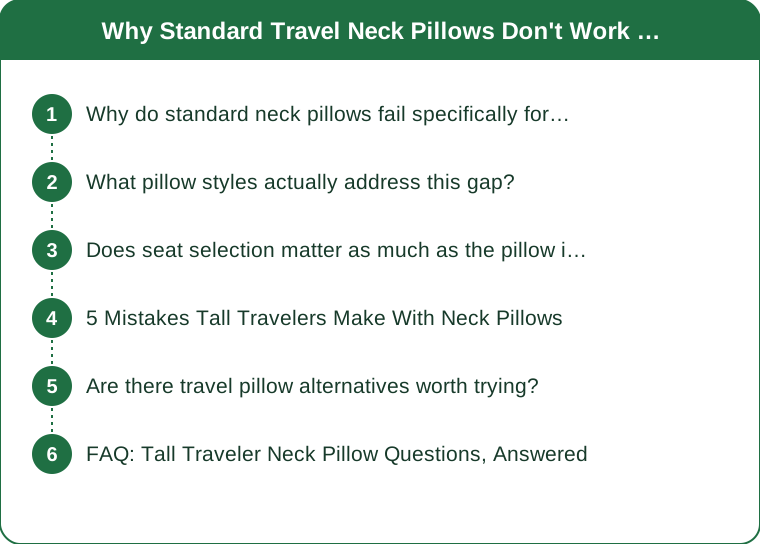
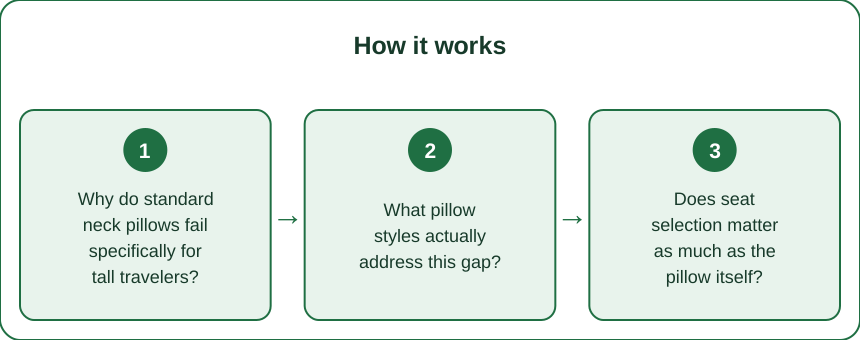
Why do standard neck pillows fail specifically for tall travelers?
Most travel pillows are designed around an average distance between shoulder and jawline, which determines how tall the pillow’s side supports need to be to actually catch your head before it tips too far. On a taller neck, that distance is often longer, meaning the same pillow height that supports an average traveler leaves a gap for a taller one — your head simply falls past where the support ends.
Seat headrest height compounds this — airplane seats are also built to an average height, so a taller traveler’s head is already positioned higher relative to the headrest than the pillow designer accounted for.
What pillow styles actually address this gap?
Wraparound or extra-tall support pillows (rather than the standard U-shape) tend to work better because they extend support higher up the sides of the head, closing the gap that standard pillows leave. Inflatable styles with an adjustable firmness dial also help, since a firmer setting provides a taller effective support height than a soft, compressed one.
Some travelers find more success with a pillow that clips or straps to the seat itself, providing a fixed support point that doesn’t depend on the pillow staying perfectly positioned around the neck through movement during sleep.
Does seat selection matter as much as the pillow itself?
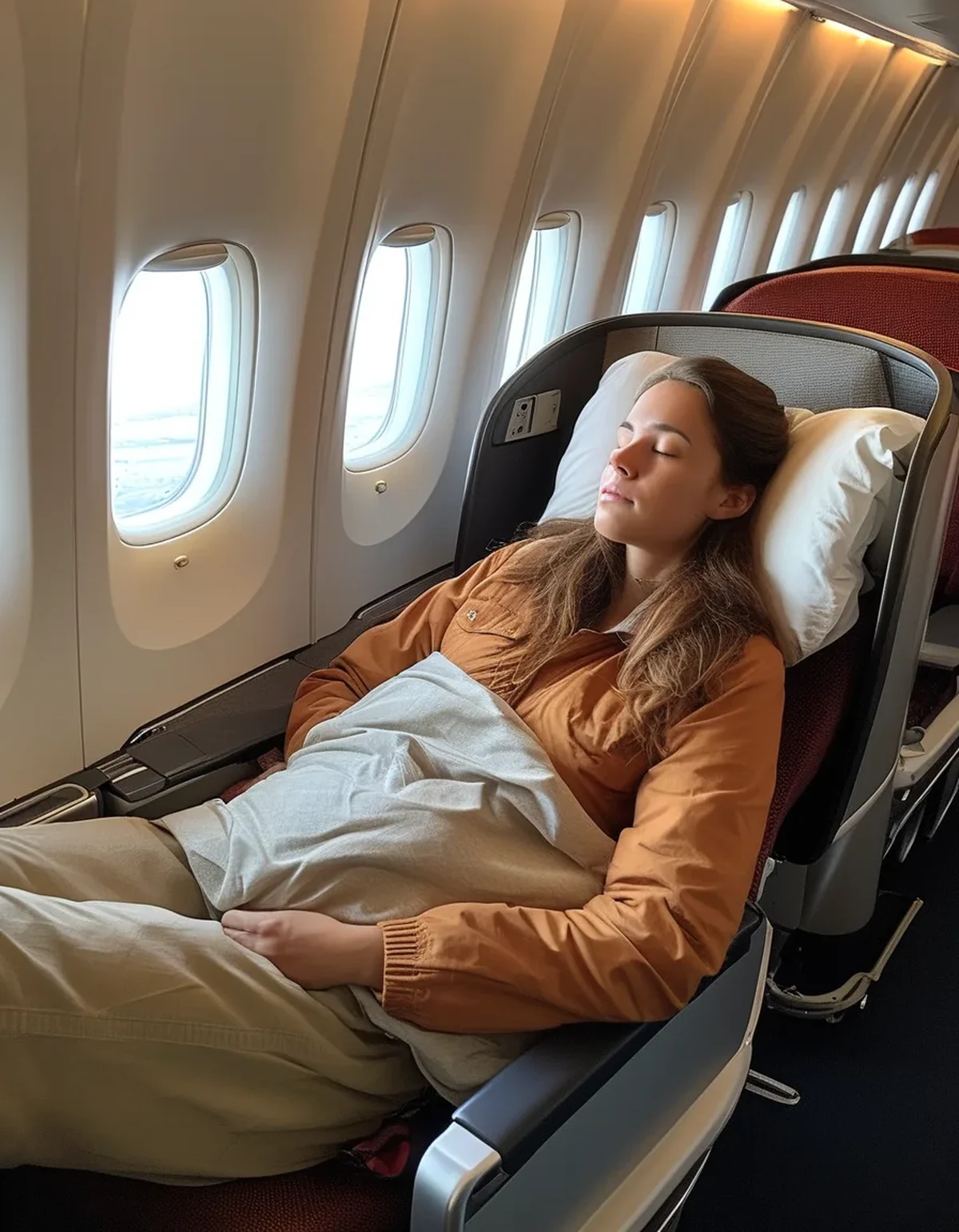
Yes — a window seat provides an additional lean point that a middle or aisle seat doesn’t, and for tall travelers this often solves more of the head-support problem than the pillow alone. Bulkhead or exit row seats with more legroom don’t typically have better headrests, so extra space doesn’t automatically mean better neck support.
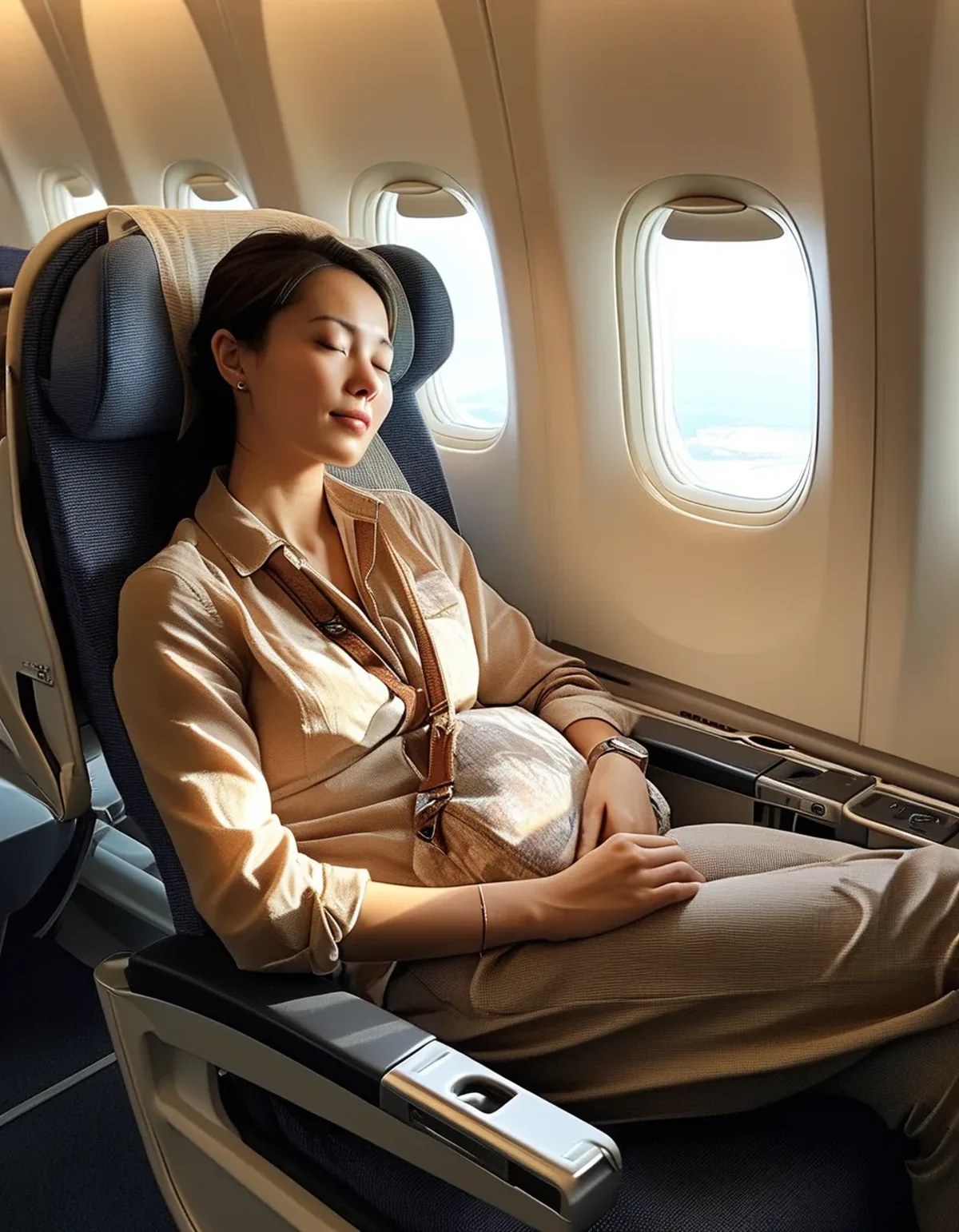
Some airlines’ seat headrests have adjustable wings that fold in around the head — checking if this feature exists on your specific route’s aircraft (via seat maps or airline apps) before flying can meaningfully change the sleep comfort outcome independent of any pillow.
5 Mistakes Tall Travelers Make With Neck Pillows
Buying based on general reviews without checking sizing for tall necks specifically. Most reviews come from average-height travelers and won’t flag this gap.
Underinflating an adjustable pillow to make it ‘softer.’ This often reduces the effective support height exactly when more height is needed.
Not testing the pillow before a long flight. A quick at-home test in a chair reveals gaps that only become obvious after hours of actual sleep attempts.
Relying on the pillow alone without using the seat’s headrest wings. Combining both support points works better than either alone.
Choosing a middle seat and expecting the same result as a window seat. The extra lean point from a window changes the whole equation.
Are there travel pillow alternatives worth trying?
A rolled jacket or scarf wedged specifically at the gap point (rather than centered behind the neck) can supplement a standard pillow’s shortfall for tall travelers without buying specialized gear. It’s not as elegant as a purpose-built solution, but it’s a free fix using what you’re already carrying.
For frequent tall travelers, investing in a higher-support inflatable or memory foam pillow specifically reviewed by tall travelers (checking travel forums rather than general retail reviews) tends to be worth the cost difference over repeatedly disappointing standard pillows.
FAQ: Tall Traveler Neck Pillow Questions, Answered
Is a memory foam pillow better than inflatable for tall travelers?
Memory foam tends to hold a more consistent support height through a flight, while inflatable pillows can shift or lose some firmness — both can work if sized generously enough, but memory foam is generally more reliable.
Does pillow height need to match exact neck measurements?
Not precisely, but a pillow marketed as ‘extra tall’ or ‘XL’ support is a meaningfully different product than a standard one, not just a marketing label.
Will any of this help with back pain from long flights too?
Indirectly — better head and neck support reduces the compensatory slouching that often contributes to back discomfort on long flights, though it’s not a complete fix for seat-related back issues.
TL;DR:
- Standard travel pillows are sized for an average neck-to-shoulder distance, leaving a support gap for taller travelers
- Extra-tall, wraparound, or firmer-adjustable pillows close that gap better than standard U-shapes
- Window seats provide an extra lean point that meaningfully helps tall travelers
- Combining seat headrest wings with a pillow works better than relying on either alone
The pillow that works for most travelers just wasn’t built with a taller neck in mind — once you know that, finding (or improvising) the right support gets a lot easier.
Keep Reading
This article is for general informational and styling purposes only. Fit, sizing, and product availability may vary.
