The Long-Haul Stretch Routine That Fits in an Economy Seat
Quick Answer: In a standard economy seat, a longer femur means the knees sit higher than the hips, which tilts the pelvis backwards and loads the lower back for the entire flight. Add restricted knee extension and you get hip flexors, hamstrings and calves all shortening at once. A routine of six seated movements done every ninety minutes, plus one aisle walk every two hours, addresses all four areas without needing space you do not have.
The seat pitch is fixed. What your body does inside it is not.
We have covered legroom seat selection, bulkhead booking, and why the aisle seat is worse than you think. This is what to do once you are in the seat you actually got.
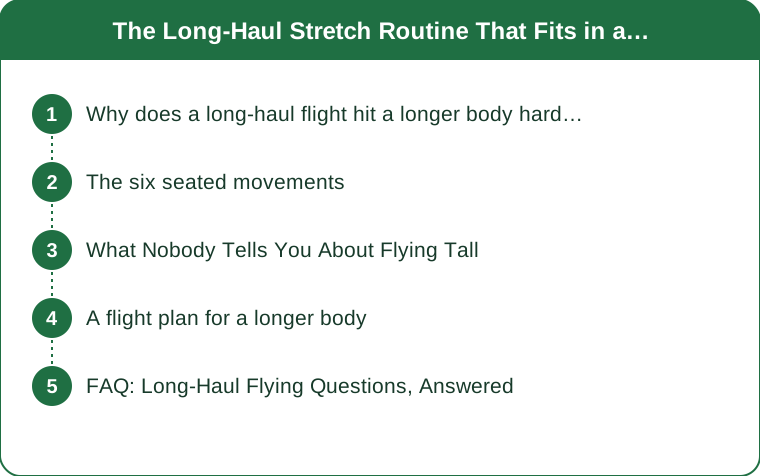
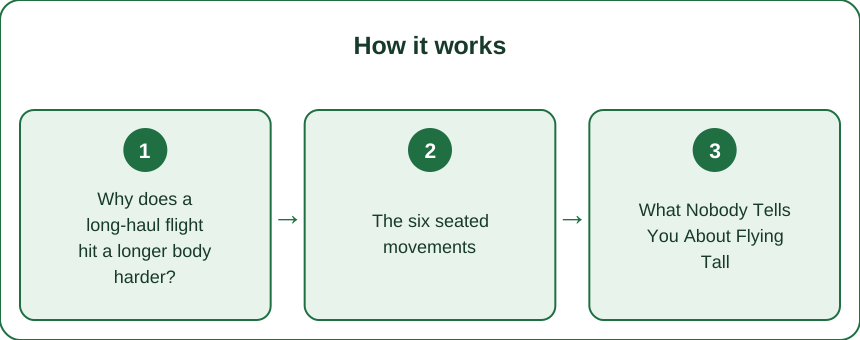
Why does a long-haul flight hit a longer body harder?
Four things happen at once, and they compound.
Knees above hips tilts the pelvis backwards. A longer femur in a fixed seat depth forces this position, and it rounds the lower back for the whole flight.
The hip flexors sit shortened for hours. Seated hip flexion held for eight hours is a genuine adaptation, which is why standing up at the end feels stiff at the front of the hip rather than the back.
Knee extension is restricted. Without room to straighten the leg periodically, the hamstrings and calves shorten and the calf muscle pump stops working properly.
Circulation slows in the lower leg. The calf pump is what returns blood from the legs, and it needs ankle movement to work. Longer legs mean a longer return path and more pooling.
Add the neck. A headrest positioned for an average height sits at mid-shoulder-blade on a taller passenger, providing no head support at all, which is why the neck ends up worse than the back on many flights.
And dehydration makes all of it worse. Cabin humidity is very low, and dehydrated tissue is stiffer tissue.
The six seated movements
All of these fit within your own seat and none of them disturb anyone.
Ankle pumps and circles. Twenty pumps, ten circles each direction. This is the single most important one, because it drives the calf pump and the circulation.
Seated marching. Lift one knee a few centimetres, hold two seconds, alternate. Twenty each side. Reactivates the hip flexors without needing space.
Glute squeezes. Ten seconds on, ten off, ten times. Counteracts the posterior pelvic tilt and takes pressure off the lower back.
Seated figure four. Ankle across the opposite knee if space allows, gentle lean forward. Thirty seconds each side. The best available hip opener in a seat.
Thoracic rotation. Arms crossed on the chest, rotate the upper body gently to each side, five each way. Addresses the mid-back stiffness that seated hours produce.
Chin tucks and shoulder rolls. Chin drawn straight back for three seconds, five times, then five slow shoulder rolls backwards. Counters both the headrest problem and the forward shoulder position.
Do the whole set every ninety minutes. It takes about three minutes and the difference on arrival is substantial.
What Nobody Tells You About Flying Tall
The aisle seat costs you a shoulder. More legroom, but cart strikes and a body that leans out are a real trade. On a very long flight, the window with a wall to lean on is sometimes the better back position even with less room.
A rolled jumper behind the lower back is worth more than a neck pillow. Supporting the lumbar curve stops the posterior pelvic tilt, which is the root of most of the discomfort.
Standard neck pillows sit wrong on a long neck. They push the head forward rather than supporting it. A rolled scarf placed higher, behind the base of the skull, usually works better.
Bulkhead is not automatically better. More legroom, but the seat width is often narrower and the armrests are fixed with the tray inside them. Exit rows generally beat bulkheads for a tall passenger.
Aisle walks matter more than the stretches. One walk every two hours does more for circulation than any seated movement, and the seated set is the fallback for when the seatbelt sign is on.
And book the seat rather than hoping. Paying for a specific extra-legroom seat on a long-haul is one of the few travel purchases that reliably pays back for a taller passenger.
This is general information, not medical advice. Anyone with a history of clotting disorders or specific medical concerns about long flights should get advice from their doctor before travelling.
A flight plan for a longer body
Seven things across a long-haul, roughly in order.
Book an aisle or exit row and check the seat map for the specific aircraft rather than the general cabin layout.
Hydrate deliberately from before boarding. Cabin humidity is very low and dehydration makes stiffness noticeably worse.
Set your lumbar support as you sit down. A rolled jumper or a small pillow at the base of the back, before you get comfortable rather than after you get sore.
Do the seated set every ninety minutes. Set a quiet timer if you are likely to sleep through it.
Walk the aisle every two hours when the seatbelt sign allows, and add ten seconds of calf raises at the back of the cabin while you are up.
Wear compression socks on flights over about six hours. The circulation benefit is larger for a longer leg, and they make a real difference to how the ankles feel on landing.
And do a proper five-minute stretch on arrival rather than going straight to a taxi. Hip flexors, hamstrings, calves and a thoracic extension over a chair back. It is the difference between a stiff evening and a normal one.
FAQ: Long-Haul Flying Questions, Answered
Why does my lower back hurt more than my legs on long flights?
Because a longer femur in a fixed seat depth puts your knees above your hips, which tilts the pelvis backwards and rounds the lumbar spine for the whole flight. Lumbar support at the base of the back addresses the cause directly.
Are exit rows or bulkheads better for tall passengers?
Usually exit rows. Bulkhead seats often have narrower seat width, fixed armrests and the tray table stowed inside them, which costs you hip room in exchange for leg room.
How often should I move on a long flight?
A seated set of ankle pumps, marching and glute squeezes every ninety minutes, and an aisle walk every two hours where possible. The ankle movements matter most, because the calf pump is what returns blood from the lower leg.
TL;DR:
- Knees above hips tilts the pelvis backwards and loads the lower back for the whole flight. Lumbar support fixes the cause.
- Ankle pumps are the most important seated movement, because the calf pump drives circulation in the lower leg.
- Run the six-movement set every ninety minutes and walk the aisle every two hours.
- Standard neck pillows sit wrong on a long neck. A rolled scarf placed higher usually works better.
You cannot buy legroom mid-flight, but three minutes every ninety changes how you arrive.
Keep Reading
This article is for general informational and styling purposes only. Fit, sizing, and product availability may vary.
