Why Hotel Pillows Are a Tall Traveler's Real Sleep Problem
Quick Answer: Hotel pillows are usually soft, overstuffed, and identical, which is a poor combination for a taller person with broader shoulders — a side sleeper with a wider shoulder needs more loft to keep the neck aligned, and a back sleeper needs less. The standard hotel pile of four soft pillows gives you either too much or too little and nothing in between. Fixing it takes two minutes with the pillows already in the room.
The bed was long enough. The neck still hurt. The variable nobody optimises for is the thing under your head.


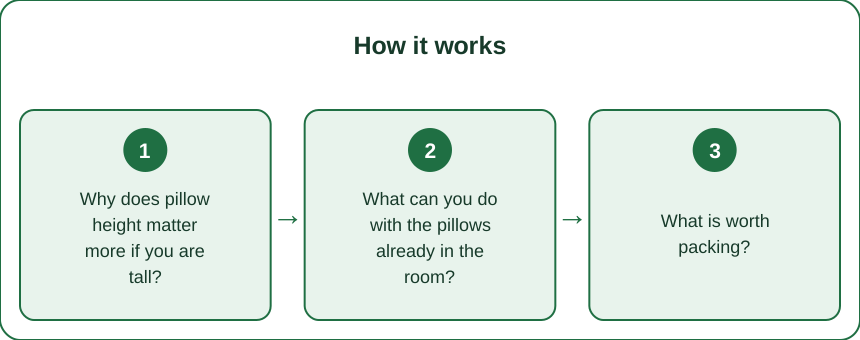
Why does pillow height matter more if you are tall?
Because loft requirement scales with shoulder width, and taller people generally have broader shoulders.
The job of a pillow is to hold your head in line with your spine, so the neck is neither flexed to the side nor extended. The gap it has to fill depends on how far your head sits from the mattress when your shoulder is bearing weight.
For a side sleeper, that gap is your shoulder width. A broader shoulder means a larger gap and a need for more loft. Put a broad-shouldered person on a thin or collapsed pillow and the head drops toward the mattress, which side-bends the neck for hours.
For a back sleeper, the requirement reverses. The gap is only the depth of the back of your head relative to your upper back, which is small. Too much loft pushes the chin toward the chest and holds the neck in flexion — which is the position most people wake up stiff from.
So a taller person needs a firm, high pillow on their side and a thin one on their back, and hotels typically supply four of the same soft medium one.
Soft is the specific problem. A soft pillow compresses under head weight and ends up thin regardless of how it looked, so it fails the side sleeper. Stacking two soft pillows does not give you a firm high one — it gives you a taller squashy pile that compresses unevenly and shifts during the night.
And there is a mattress interaction. A soft hotel mattress lets your shoulder sink in, which reduces the gap and means you need less pillow than you would at home. A firm mattress keeps the shoulder up and increases the gap. So the same pillow behaves differently in two hotels, which is why this feels unpredictable.
What can you do with the pillows already in the room?
Quite a lot, and it takes two minutes before you get into bed.
First, find the firmest one. Hotels frequently supply a mix — two soft and two firmer, or a feather and a foam pair. Press each one with your palm and use the one that pushes back. The firmer one usually has a different tag or a denser feel at the corners.
Then, for a side sleeper who needs more loft:
- Fold one pillow in half and put it under a second, flat one. A folded pillow is roughly twice as firm and holds its height, which is exactly what stacking two flat ones fails to do.
- Or roll a bath towel and place it inside the pillowcase under the neck end. This is the single most effective hotel fix available — it gives you targeted support exactly where the neck needs it, and it does not compress.
- Aim for your head and neck in a straight line with your spine, checked by feel: your nose should point straight ahead, not up or down.
For a back sleeper who needs less loft:
- Use one pillow only, and choose the flattest.
- If everything is too high, sleep on the pillow’s edge or fold the pile out of the way and use a folded towel instead.
- Put a spare pillow under your knees, which reduces lower-back strain and is more useful there than under your head.
For anyone with a too-short bed as well: move the pillows up so your head is closer to the headboard, or remove the decorative bolster entirely — the pile of extra pillows at the head of the bed is stealing 6 to 10 inches of usable mattress length, which for a tall person is the difference between feet on the mattress and feet off the end.
What is worth packing?
One or two small items that solve most of it, chosen for packability rather than comfort maximalism.
A packable pillowcase. Weighs nothing, takes no space, and lets you stuff it with clothing to make a pillow of exactly the loft you need. This is the most flexible option available — a folded fleece or a rolled sweater inside a familiar case gives you a firm, custom-height support and it is genuinely comfortable.
A compressible travel pillow, used as a supplement rather than a replacement. Compressed foam or down-alternative pillows pack to the size of a water bottle and give you a known quantity to fold, stack, or place under a hotel pillow. The point is not to replace the hotel pillow but to have a firm insert.
A rolled towel is free and available in every hotel room, so it does not need packing at all — but knowing to use it is the item.
What is not worth packing: a full-size pillow from home, unless you are driving. It solves the problem perfectly and costs you a carry-on. And neck pillows designed for aircraft, which are shaped for upright sitting and are the wrong geometry for lying down.
One more genuinely useful item for tall travelers: a request, made at booking. Ask for a firm pillow and, where available, a longer bed — many hotels stock firm pillows on request and simply do not offer them by default. It costs an email and it works more often than people expect.
And know the bed sizes. US king and queen mattresses are 80 inches long; a standard US double or full is 75 inches, which is genuinely short for anyone over about 6’1 once you account for pillows. In much of Europe, standard lengths run 190 to 200 cm, and the longer option is often available on request. Asking about mattress length rather than bed width is the question that actually matters.

What Nobody Tells You About Travel Sleep and Height
The decorative pillow pile is costing you bed length. Four to six pillows stacked at the head of a bed occupy 6 to 10 inches of the mattress. Taking them off entirely and sleeping higher up the bed is free and it is the fastest fix for feet hanging off the end.
Tucked sheets restrict tall sleepers disproportionately. Hotel sheets are tucked tightly at the foot, which pins your feet into plantarflexion if you are long enough to reach the end. Untuck the foot of the bed before you get in — it takes ten seconds and it prevents both calf cramping and the ankle ache people blame on the flight.
Two thin pillows are not one thick pillow. They compress unevenly and slide apart during the night, so you wake up with your head between them. One folded pillow is firmer and more stable than two flat ones, which is the opposite of what most people try first.
Your neck position is set by your shoulder, not your head. A pillow that supports the head and leaves a gap at the neck lets the neck extend into that gap. The support needs to be under the cervical curve — which is precisely what a rolled towel at the neck end of the pillowcase achieves and what a big soft pillow does not.
Hotel mattress firmness changes your pillow requirement. A soft mattress means less pillow, a firm one means more, so the setup that worked last trip may not work this trip. Check alignment on the first night rather than assuming.
And sleeping position matters more when the bed is wrong. Side sleeping tolerates a short bed better than back sleeping — you can bend your knees. Back sleeping on a too-short mattress puts your feet off the end or your knees permanently bent, neither of which is restful. If the bed is short, side sleeping with a properly lofted pillow is the more workable combination.
What does a two-minute setup routine look like?
A checklist you run when you walk into the room, before you are tired.
Do it on arrival, not at bedtime. Twenty minutes after you land you have the patience to rearrange a bed; at midnight you do not.
The routine:
- Remove all decorative pillows and bolsters from the bed. Put them on a chair. You have just gained several inches of usable length.
- Press each remaining pillow and rank them by firmness. Keep the firmest for your head.
- Untuck the sheets at the foot of the bed.
- Set your pillow height for your sleeping position — folded or towel-augmented for side sleeping, single and flat for back sleeping.
- Lie down and check alignment. On your side, your nose should point straight ahead and your chin should not be tucked or tipped. On your back, your chin should be neither pushed to your chest nor tipped up.
- Put a spare pillow under your knees if you sleep on your back, or between your knees if you sleep on your side. On a side sleeper, a pillow between the knees stops the top leg dragging the pelvis into rotation, which matters more with longer legs.
- Call the desk for a firm pillow if nothing in the room is firm enough. Most hotels have them and will bring one up.
Then two habits for the trip. Repeat the check on the first night in every new room — the mattress changes and so does the requirement. And if you travel often, keep a note of which hotels and chains have long beds and firm pillows available, because that is genuinely useful information you will otherwise re-derive every trip.
Seasonal note: as travel picks up through the autumn and holiday season, hotels are fuller and room requests get honoured less reliably — which makes the packable pillowcase and the towel trick more valuable than a request made at the desk on arrival. If neck pain persists for more than a few days after a trip, or comes with arm numbness or tingling, get it looked at rather than blaming the pillow. This is general information, not medical advice.
FAQ: Tall Travelers and Hotel Sleep, Answered
Should I ask the hotel for a firm pillow?
Yes, and ask at booking rather than at check-in. Many hotels keep firm or high-loft pillows for exactly this request and simply put the soft standard ones on the bed by default. It costs nothing, and it is more likely to be available before the room is made up than after.
Is a travel pillow worth packing for hotel beds?
A compressible one used as a firm insert is genuinely useful, because it gives you something with known loft to fold or stack under a soft hotel pillow. A U-shaped aircraft neck pillow is the wrong shape for lying down and will not help. The cheapest effective option is a packable pillowcase you stuff with clothing.
Why do I wake up stiff even in an expensive hotel?
Expensive hotels tend to use very soft, very full down pillows, which look luxurious and compress to almost nothing under a head. For a broad-shouldered side sleeper that is close to the worst option available, regardless of price. Firmness and loft matter for alignment; softness is a comfort feature that works against you here.
TL;DR:
- Pillow loft requirement scales with shoulder width, so broader-shouldered side sleepers need more support than hotels supply
- Soft hotel pillows compress to nothing under a head, and two soft ones do not equal one firm one
- Fold a pillow or roll a towel inside the pillowcase at the neck end — the most effective free fix in any room
- Remove the decorative pillow pile and untuck the foot of the bed to reclaim length and ankle position
- Pack a spare pillowcase, ask for a firm pillow at booking, and re-check alignment in every new room
You solved the mattress length and stopped there. The two minutes it takes to rank the pillows and roll a towel is the rest of the fix, and it works in every hotel room you will ever walk into.
Keep Reading
This article is for general informational and styling purposes only. Fit, sizing, and product availability may vary.
